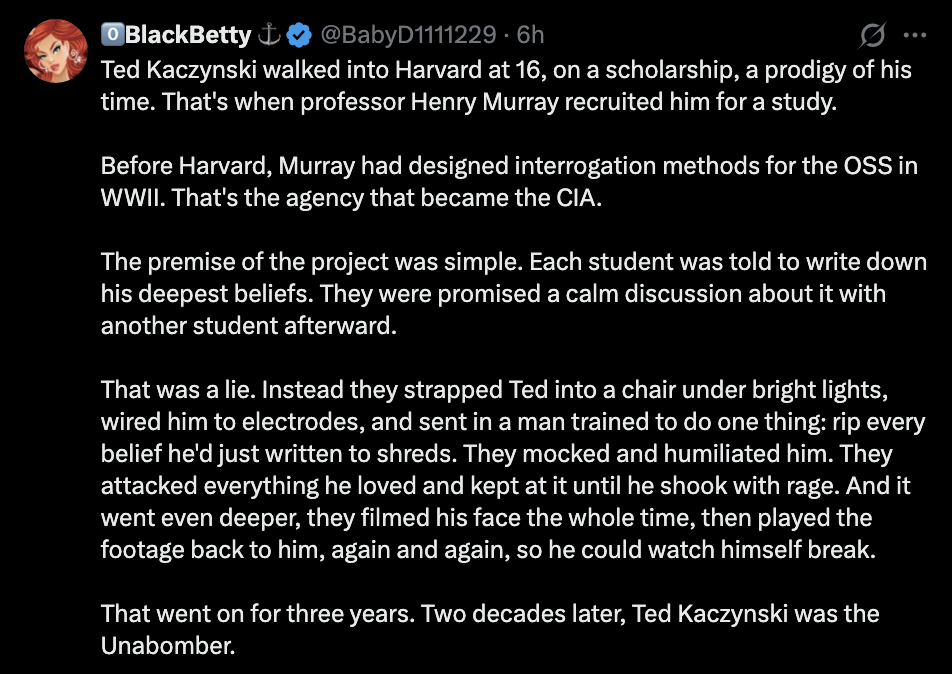
Ted Kaczynski entered Harvard in 1958 at age 16 to study mathematics. From 1959 to 1962, he was among 22 students in Henry Murray’s study of how people withstand interrogation, humiliation and emotional pressure. The research was intended to inform interrogation methods for government and law enforcement officials.
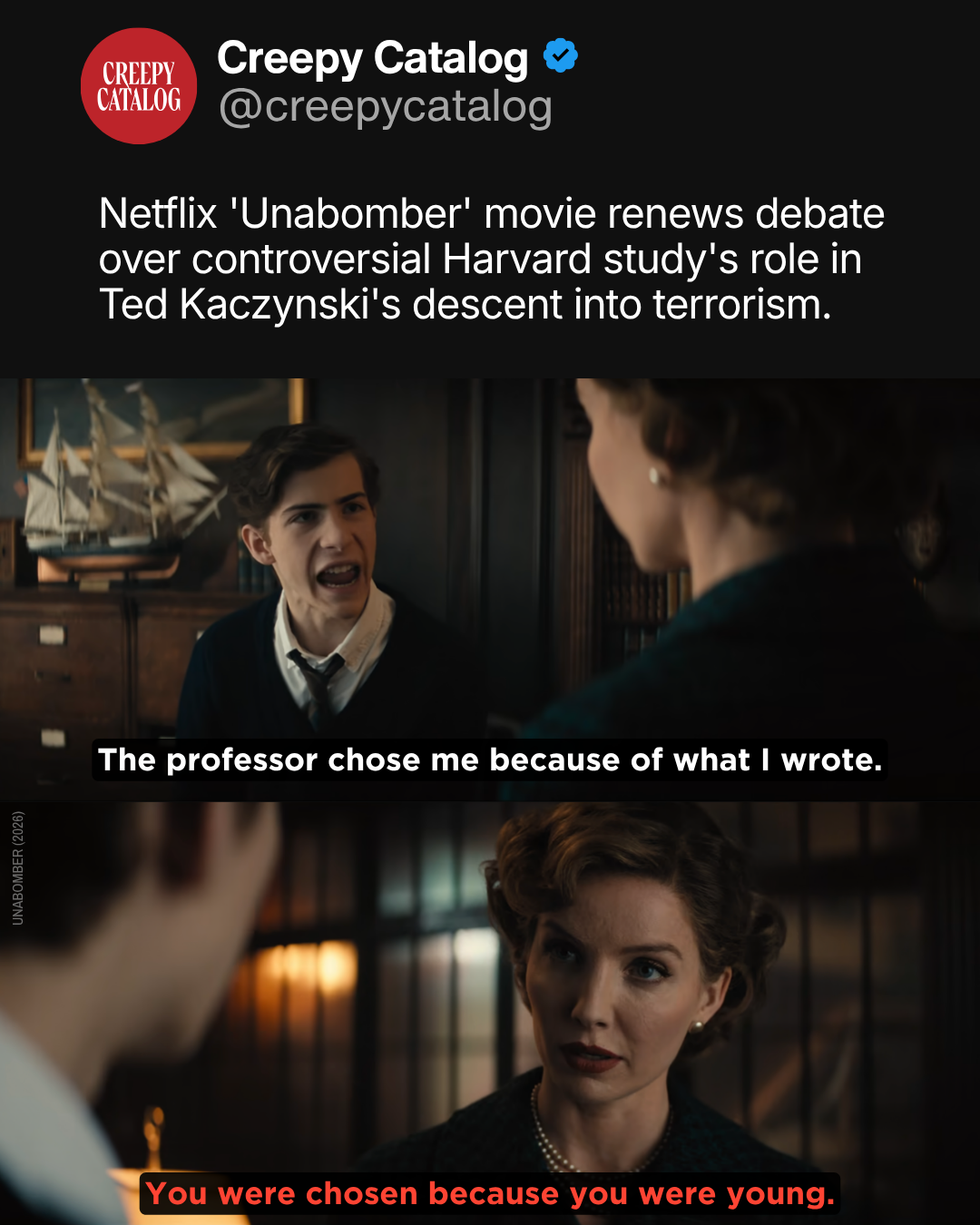
Russell Crowe plays the Harvard psychologist in Netflix’s Unabomber movie, bringing renewed attention to the professor who subjected Kaczynski to 200 hours of intense psychological testing years before his bombing campaign. Whether those experiments contributed to his later violence remains disputed. A direct link hasn’t been established.

Participants wrote about their beliefs and personal philosophies. Researchers then turned those essays into material for attacks on the students’ convictions. Murray reportedly directed his team to demean their ideas during interrogations he described as “vehement, sweeping and personally abusive.”
The students were connected to electrodes in brightly lit rooms, and their responses were filmed and analyzed. They later had to watch recordings of the encounters, sometimes more than once. Kaczynski’s participation ended in 1962, the year Murray retired.
Dr. Ann Wolbert Burgess, a pioneer of the FBI’s Behavioral Science Unit, has criticized the study’s ethics and its treatment of young participants. She argued that attacking their academic work meant attacking something central to their identities at that age: “They were being demeaned for that, or devalued for that in this critical time.”
Kaczynski went on to conduct a 17-year mail-bombing campaign that killed 3 people and injured 23. After pleading guilty to all federal charges against him, he received 4 consecutive life sentences plus 30 years, without parole.
Following his 1996 arrest, investigators examined the Harvard experiments and their possible lasting effects. In 2000, the Murray Research Center sealed his study records. Its director at the time, Annemette Sorensen, said the file had been permanently removed because the center could no longer protect its confidentiality.
The experiments’ potential harm and their role in Kaczynski’s terrorism are separate questions. Evolutionary psychologist Nigel Barber cautioned against treating the study as a major cause of Kaczynski’s political beliefs: “The Harvard experiment was stressful and stress aggravates the symptoms of schizophrenia. Otherwise, it would be a mistake to exaggerate the importance of this experience, or to see it as a major determinant of his anti-science and anti-technology political views.”