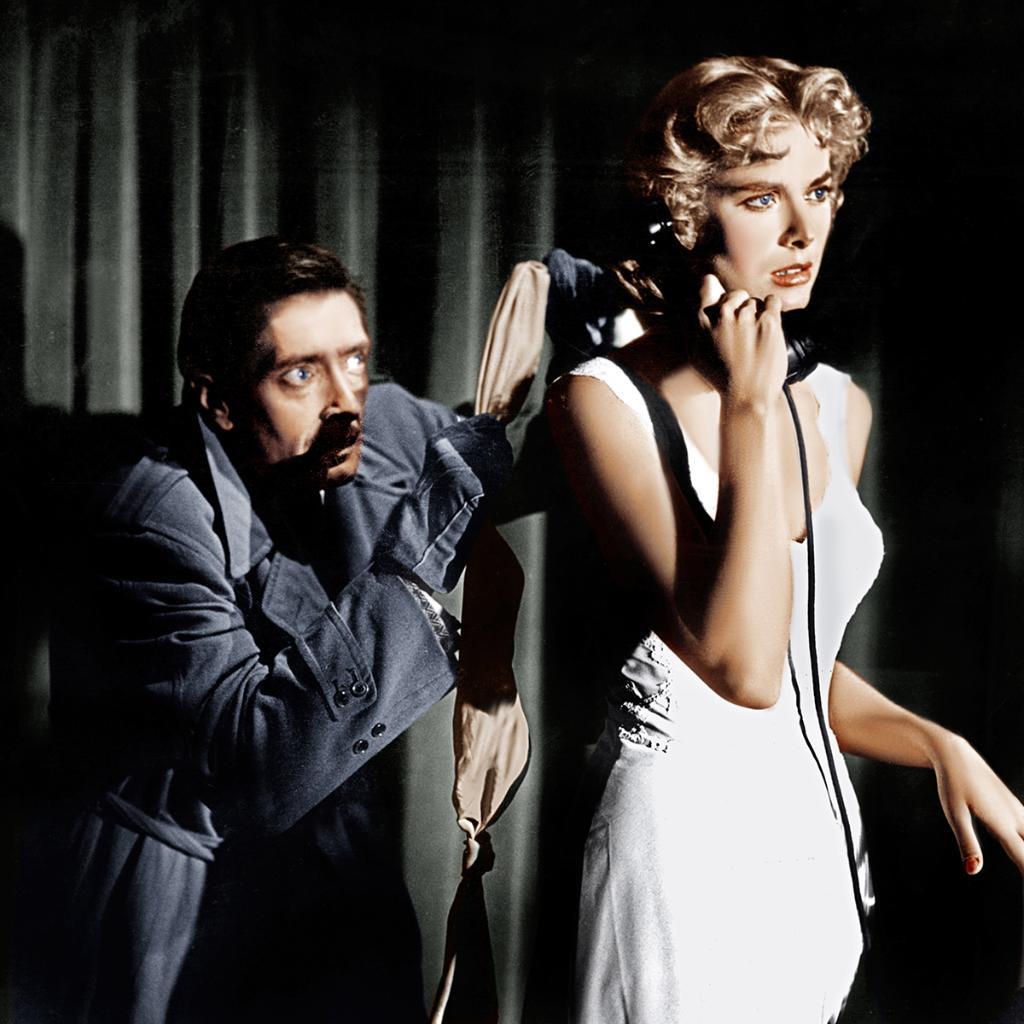
The hired killer’s target fights back in Alfred Hitchcock’s Dial M for Murder (1954), leaving the husband who arranged the attack to improvise. Ray Milland plays Tony Wendice, whose carefully timed alibi depends on someone else murdering his wife, Margot, played by Grace Kelly.
Tony’s a former tennis professional who married Margot largely for her fortune. After discovering she’d had an affair with American mystery writer Mark Halliday (Robert Cummings), he uses an old Cambridge acquaintance’s criminal past to blackmail him into carrying out the killing.
A telephone call is supposed to bring Margot within reach, and a concealed key gives her attacker access to the couple’s London apartment.
Margot survives the attack with a pair of scissors. Tony then works to turn the evidence against her, making the suspense depend on whether his revised account can survive scrutiny.
The audience already knows who’s behind the scheme; the danger lies in how convincingly he can make someone else look guilty.
Adapted from Frederick Knott’s play, the 105-minute film keeps most of its action inside the Wendices’ apartment. Hitchcock uses that limited space to make the placement of ordinary objects matter, with the telephone, scissors and keys becoming crucial to the plot.
Warner Bros. required the film to be shot in 3D, and Kelly’s reach toward the camera during the attack became one of its signature moments. Most theaters ultimately showed it in 2D.
It was Kelly’s first film with Hitchcock, followed by Rear Window and To Catch a Thief.