Before creating Pokémon Go, John Hanke co-founded Keyhole in 2001, bringing satellite and aerial imagery together in an interactive map. After the dot-com crash left the company short of funding, In-Q-Tel, an independent nonprofit venture firm funded mainly through CIA contracts, invested in February 2003. The deal was reported at about $2 million.
It was In-Q-Tel’s 1st investment on behalf of the National Imagery and Mapping Agency, which supplied the funding through the venture firm. NIMA used Keyhole’s technology to support US troops in Iraq that same year.
Google bought Keyhole in October 2004 for a reported $35 million in stock and relaunched its product as Google Earth. Hanke stayed on to lead Google’s Geo division, including Earth, Maps and Street View, then started Niantic inside Google around 2010.
Pokémon Go arrived on July 6, 2016, and Apple confirmed it had more first-week downloads than any prior app in the iOS App Store. On October 20, 2020, the game added optional AR Mapping tasks that rewarded players with in-game items for scanning real PokéStops with their phone cameras.

Those scans added up. Niantic Spatial trained its visual-positioning model on 30 billion urban images crowdsourced from Niantic games. Niantic later clarified that the total counts video frames from scans across games, including Ingress and Pokémon Go.
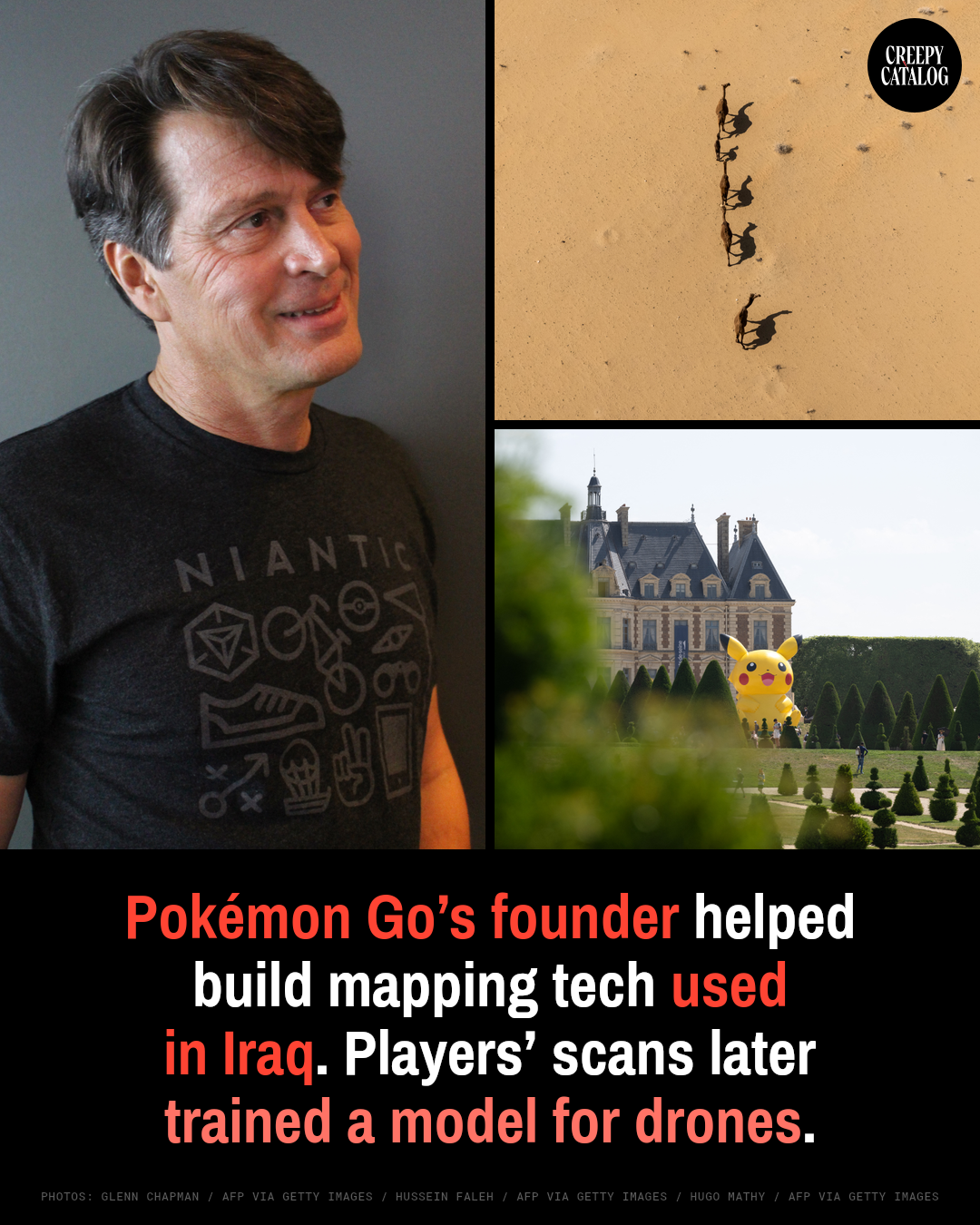
In December 2025, Niantic Spatial and Vantor announced a joint system designed to let drones and ground units share coordinates without GPS, combining ground-level visual positioning with aerial terrain data. Vantor, formerly Maxar Intelligence, holds US defense and intelligence contracts.
Niantic Spatial says sharing player scans is “not part of the agreement,” and Vantor says it has no access to any Pokémon Go dataset. The scans were an input to the model.
Scopely, owned through Savvy Games by Saudi Arabia’s Public Investment Fund, bought Niantic’s games business for $3.5 billion. The deal was announced in March 2025 and closed on May 29, while Hanke took the geospatial business into Niantic Spatial.
Hanke moved from CEO to executive chairman in March 2026. He said that getting a robot to move and getting Pikachu to run around “is actually the same problem.”